The East Village Windmill

The story of the East Village windmill has been almost entirely forgotten, scrubbed from the memories of New Yorkers that have moved away and been replaced. The windmill's presence in the East Village was a symbol of community action, a landmark in a city struggling to find its way through economic turbulence.
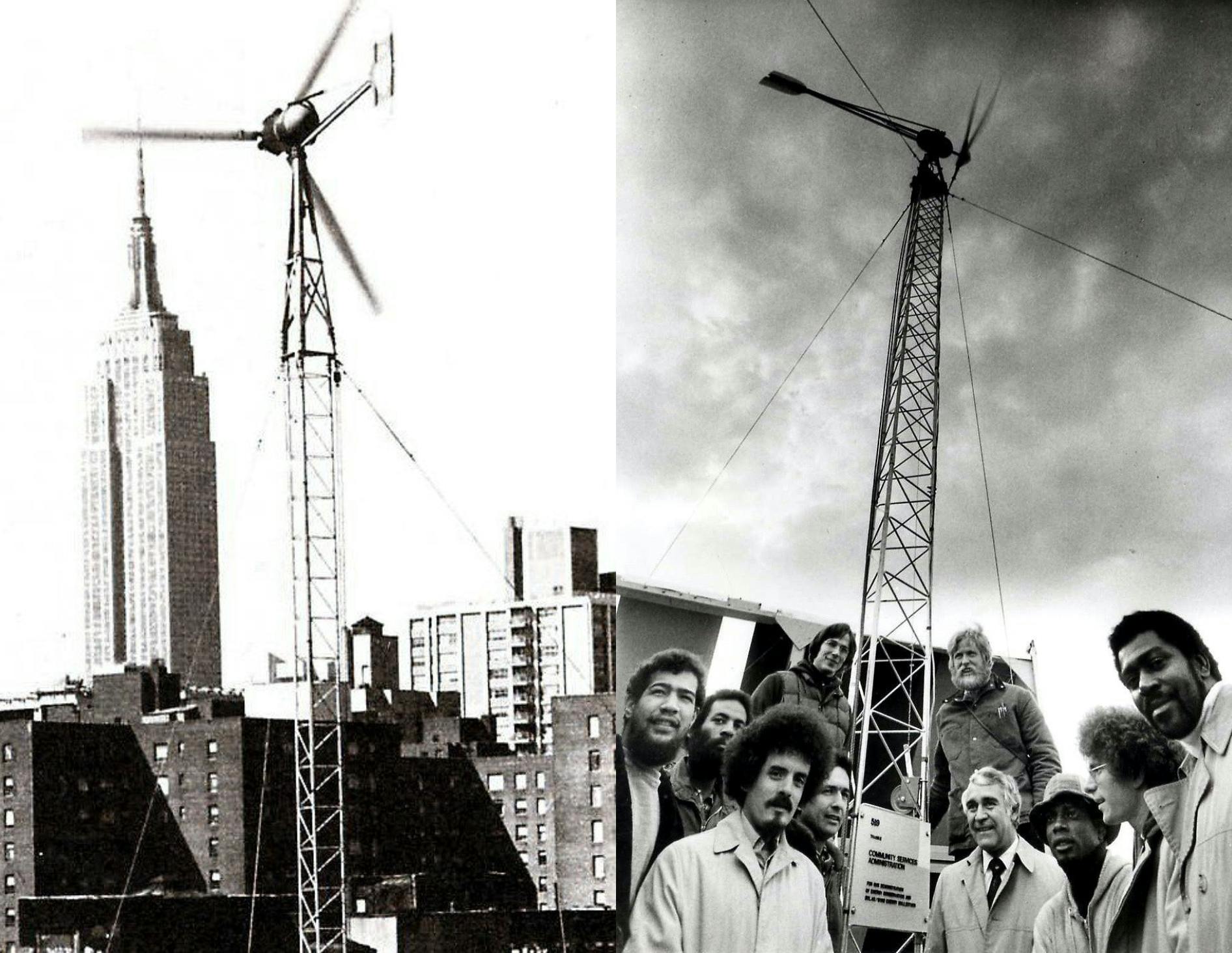
The East Village windmill and the community that built it - flexfarmd building renewable energy microgrids

In 1976, a grassroots renewable advocate named Travis Price arrived in New York from New Mexico, where he had been building small-scale solar and wind utilities. Tapped by the Nixon administration to research renewable energy in response to the hardships experienced by the oil embargo, Price began searching for communities that could benefit from DIY, community-led power initiatives in New York City.

Focusing his search on the struggling East Village, Price sought low income housing, squats, and co-ops (the old school co-ops, not today's). Price wanted to bring independence to the downtrodden, providing them a tool to save money on utility bills while rebuilding their community. Price found the perfect building, shoddy and nearly destroyed, in the midst of a budget reconstruction. They had only $300 in their budget for insulation, in a city that averages 10' of snow annually. These were the people, ignored by the city, that needed self-sufficiency. They started by installing solar panels and batteries on the roof, "borrowed" from Yale.

This first trial grabbed the attention of architecture students from MIT and Yale, who began to explore other opportunities for homegrown power collection at small scales. Architecture at that time, led by Archigram, Ant Farm, Buckminster Fuller, and Hans Rucker, was also experimenting with a radical reimagination of cities and communities. Price, with the help of these architecture students, began to completely rehabilitate a single building in the neighborhood, slowly becoming part of the fabric of the East Village. After receiving 30 grant-funded solar panels, the team installed them on the roof and cut the building utility costs by 60%.

Initially these projects were entirely solar. Wind energy had yet to reach mass production, and most wind turbines had been built as one-offs on farmland in America's heartland. The team found a single Jacobs brand turbine capable of 2kW in the midwest and installed it alongside the solar panels on the roof. It was huge for the time: 12' in diameter, 50' tall, and capable of powering the lights in the building and any pumps for the solar system. This giant monument sat on top of the building in the East Village, drawing more attention from the community. One blade said "El Movimiento de la Calle Once," the 11th street movement. They requested no permits, they just installed it, and they watched the power meter spin backwards with excess energy.

The windmill, with someone servicing it, in the East Village - flexfarmd building renewable energy microgrids

The power company quickly sued the movement, first arguing that technical implementation would interfere with the frequencies of the larger grid, before getting to the heart of the matter: communities and utilities generating power at the same time. A power dynamic in every sense. Ultimately, the courts ruled in favor of the community. This led to the passage of the Public Utility Regulatory Policies Act (PURPA), which ended the utilities' monopoly on power and gave people the foundation for our more recent solar and renewable trends.

The independence that the windmill brought was unparalleled. During the 1977 blackout, the entire city was plunged into darkness with the exception of this one building. The movement's push for self-sufficiency brought the community together, it saved money and broke a monopoly on power, and it brought renewable energy into the public conscience. The energy and imagination that the team brought to building radical alternatives is the same spirit that we need to foster today.
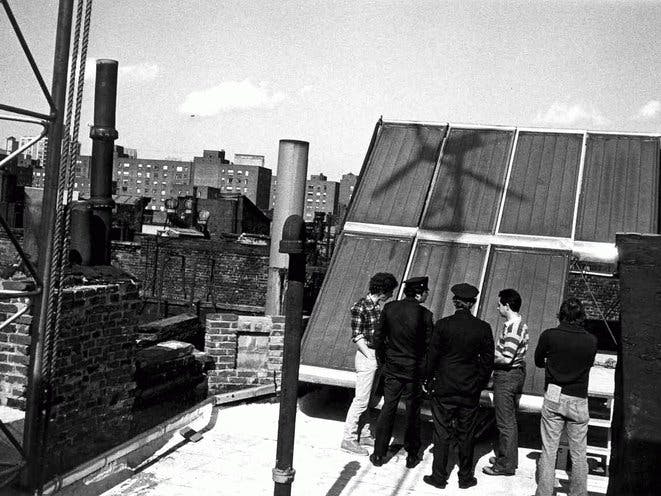
Police offer on roof of building with windmill shadow - flexfarmd building renewable energy microgrids

In the face of overwhelming global displacement, often caused by catastrophic climate change, we need windmills and solar panels on every roof, in every yard, on every abandoned lot. No individual can bear sole responsibility for saving the world, but together, one small action has exponential effects.


The East Village Windmill

The story of the East Village windmill has been almost entirely forgotten, scrubbed from the memories of New Yorkers that have moved away and been replaced. The windmill's presence in the East Village was a symbol of community action, a landmark in a city struggling to find its way through economic turbulence.

The East Village windmill and the community that built it - flexfarmd building renewable energy microgrids

In 1976, a grassroots renewable advocate named Travis Price arrived in New York from New Mexico, where he had been building small-scale solar and wind utilities. Tapped by the Nixon administration to research renewable energy in response to the hardships experienced by the oil embargo, Price began searching for communities that could benefit from DIY, community-led power initiatives in New York City.

Focusing his search on the struggling East Village, Price sought low income housing, squats, and co-ops (the old school co-ops, not today's). Price wanted to bring independence to the downtrodden, providing them a tool to save money on utility bills while rebuilding their community. Price found the perfect building, shoddy and nearly destroyed, in the midst of a budget reconstruction. They had only $300 in their budget for insulation, in a city that averages 10' of snow annually. These were the people, ignored by the city, that needed self-sufficiency. They started by installing solar panels and batteries on the roof, "borrowed" from Yale.

This first trial grabbed the attention of architecture students from MIT and Yale, who began to explore other opportunities for homegrown power collection at small scales. Architecture at that time, led by Archigram, Ant Farm, Buckminster Fuller, and Hans Rucker, was also experimenting with a radical reimagination of cities and communities. Price, with the help of these architecture students, began to completely rehabilitate a single building in the neighborhood, slowly becoming part of the fabric of the East Village. After receiving 30 grant-funded solar panels, the team installed them on the roof and cut the building utility costs by 60%.

Initially these projects were entirely solar. Wind energy had yet to reach mass production, and most wind turbines had been built as one-offs on farmland in America's heartland. The team found a single Jacobs brand turbine capable of 2kW in the midwest and installed it alongside the solar panels on the roof. It was huge for the time: 12' in diameter, 50' tall, and capable of powering the lights in the building and any pumps for the solar system. This giant monument sat on top of the building in the East Village, drawing more attention from the community. One blade said "El Movimiento de la Calle Once," the 11th street movement. They requested no permits, they just installed it, and they watched the power meter spin backwards with excess energy.

The windmill, with someone servicing it, in the East Village - flexfarmd building renewable energy microgrids

The power company quickly sued the movement, first arguing that technical implementation would interfere with the frequencies of the larger grid, before getting to the heart of the matter: communities and utilities generating power at the same time. A power dynamic in every sense. Ultimately, the courts ruled in favor of the community. This led to the passage of the Public Utility Regulatory Policies Act (PURPA), which ended the utilities' monopoly on power and gave people the foundation for our more recent solar and renewable trends.

The independence that the windmill brought was unparalleled. During the 1977 blackout, the entire city was plunged into darkness with the exception of this one building. The movement's push for self-sufficiency brought the community together, it saved money and broke a monopoly on power, and it brought renewable energy into the public conscience. The energy and imagination that the team brought to building radical alternatives is the same spirit that we need to foster today.

Police offer on roof of building with windmill shadow - flexfarmd building renewable energy microgrids

In the face of overwhelming global displacement, often caused by catastrophic climate change, we need windmills and solar panels on every roof, in every yard, on every abandoned lot. No individual can bear sole responsibility for saving the world, but together, one small action has exponential effects.